Rust OAuth2 Server: Four Months of Progress from v0.0.3 to v0.5.2
It has been a busy four months for the Rust OAuth2 Server. When I last wrote about the project at the end of December 2025 (Actor-Model Concurrency for Secure OAuth2), it was a single-crate Actix app with the core grants, introspection, revocation, discovery, and a minimally usable admin surface. Sixteen releases and over 150 PRs later, it looks very different.
This post is a progress update: what shipped, why it matters, and what the control plane looks like now.
- Repo: https://github.com/ianlintner/rust-oauth2-server
- Docs site: https://ianlintner.github.io/rust-oauth2-server/
- Latest release: v0.5.2
TL;DR
| Area | Then (2025-12-30) | Now (2026-04-20, main) |
|---|---|---|
| Shape | Single crate | Cargo workspace — 12 crates (oauth2-core, oauth2-actix, oauth2-storage-*, oauth2-ratelimit, oauth2-resilience, oauth2-events, etc.) |
| RFC coverage | Core grants, introspection, revocation, discovery | + Device flow (RFC 8628), PAR (RFC 9126), JAR (RFC 9101), JWT introspection response (RFC 9701), Dynamic Client Registration (RFC 7591/7592), JWT client auth (RFC 7523), OIDC Session Mgmt + back/front-channel logout |
| Storage | Postgres/MySQL via SQLx | + MongoDB / CosmosDB backend with compatibility fixes |
| Admin UI | Minimal HTML admin | Tailwind overhaul, dark mode, server-side paging, drawers, bearer-token API, MCP admin tools |
| Keys | Static JWKS | KeySet with rotation, AES-256-GCM at-rest encryption, grace period, POST /admin/api/keys/rotate |
| Rate limiting | None | oauth2-ratelimit crate — token bucket, in-memory or Redis, Actix middleware, Prometheus metrics |
| Resilience | None | oauth2-resilience crate — circuit breaker, bulkheads, back-pressure with Prometheus observability |
| Security | Baseline | CORS fail-closed, CSP, session-ID renewal on login, HTTP security headers, insecure-default guards, RUSTSEC patches, StdRng::from_os_rng(), Semgrep + CodeQL + Snyk in CI |
| Benchmarks | Manual | Weekly k6 CI across 5 servers (see this post) |
| Ops | Kustomize manifests | + Caretaker agentic repo maintenance, LLM-driven security scan framework, MCP server, weekly doc reconciliation |
The Admin Control Plane
The most visible change is the operator experience. The previous admin UI was a working-but-plain HTML surface. In April it was rewritten on top of Tailwind + Alpine.js, with server-side paging, a proper dark mode, and a live dashboard that reads the same /metrics endpoint Prometheus scrapes.
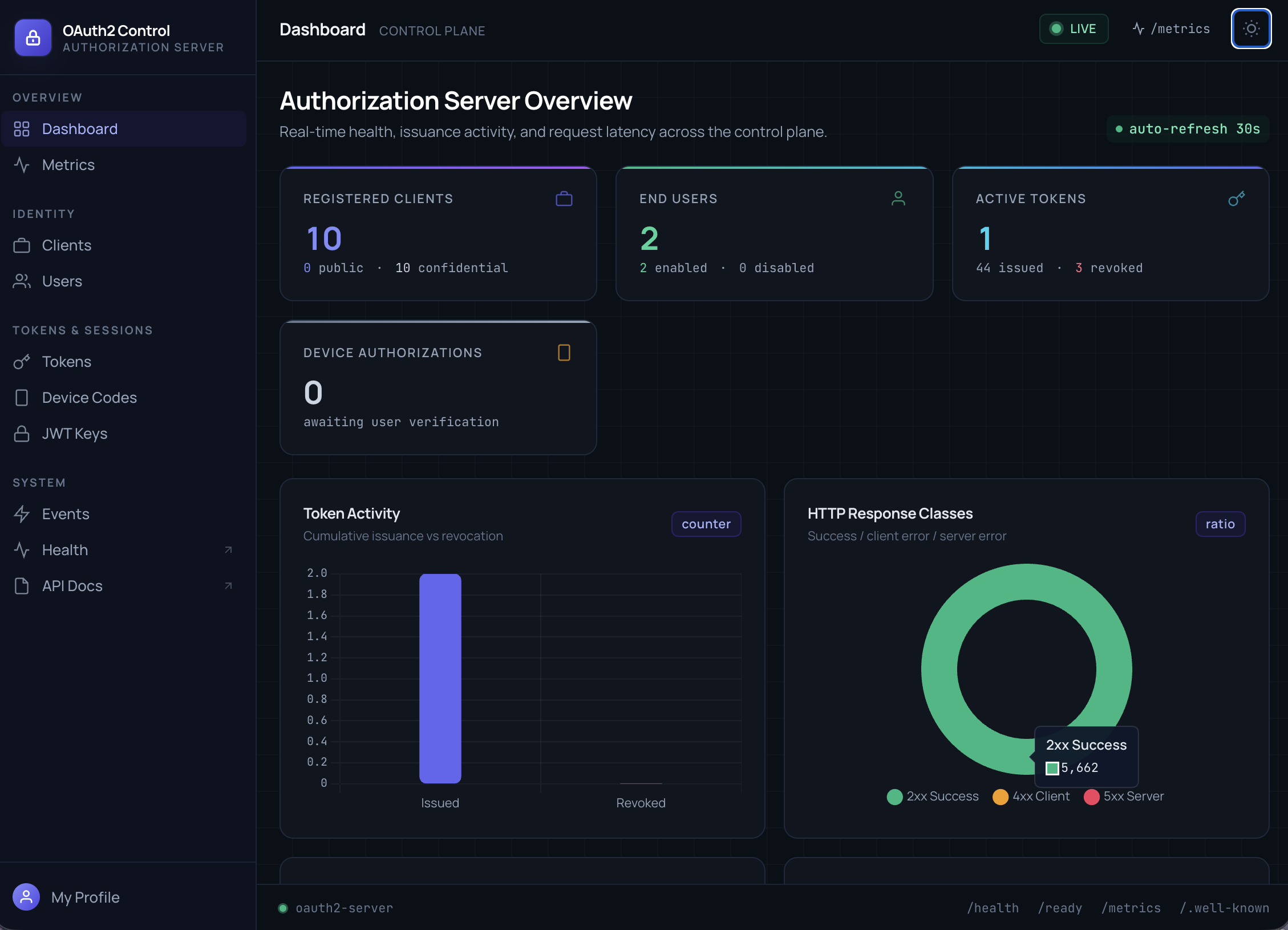
The dashboard is intentionally read-through: every tile is computed live from Prometheus counters/gauges with a 30-second auto-refresh. That means the admin dashboard and your monitoring system can never disagree about what the server did — there is no second database of “admin-visible state” to drift.
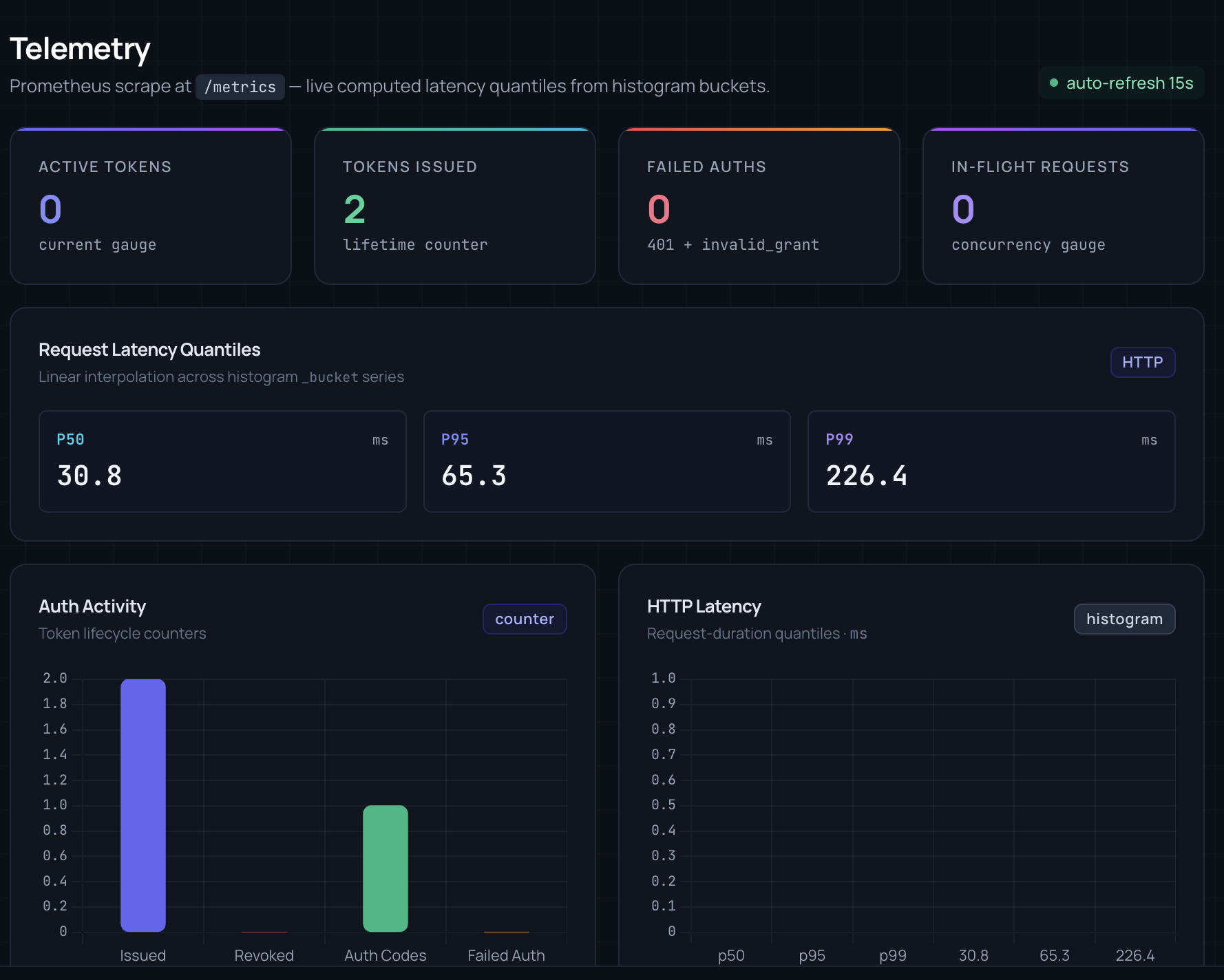
A dedicated Telemetry view shows the histogram-derived latency quantiles and token lifecycle counters:
Under the hood:
- Bearer-token auth on the admin API, with a separate admin MCP server so Claude Code / Copilot agents can operate the control plane through structured tools rather than scraping HTML.
- Admin role guard keyed off a
rolecolumn on the users table — non-admins get a real 403 page instead of a silent redirect. - CSP: admin HTML ships with a locked-down Content-Security-Policy and an SRI-pinned Alpine bundle; drawers use
x-ifso state is fully removed from the DOM when closed. - Key rotation UI: the JWKS page has a rotate action gated behind a real modal (moved to
bodylevel so it escapes any ancestoroverflow: hidden), with backdrop + Escape dismissal.
Waves 2–5: RFC Conformance Plan
A recurring theme has been a phased conformance plan. The OAuth 2.0 spec audit catalogues ~30 RFCs and stack-ranks the gaps. Each “wave” picks a thematic slice:
Wave 2 — OIDC Core & refresh-token security
- Refresh-token rotation with replay detection via token-family lineage (a reused refresh token revokes the whole family)
nonceround-trip verification end-to-endc_hashclaim in ID tokens for hybrid-flow binding- Dynamic Client Registration (RFC 7591) + Management (RFC 7592)
- JWT client authentication (RFC 7523) —
private_key_jwt+client_secret_jwt
Wave 3 — security hardening
- Rate limiting (in-memory + Redis) with token bucket and atomic Lua INCR+EXPIRE
- JWT signing-key rotation with AES-256-GCM at-rest encryption and a grace period
- Stricter redirect-URI validation; CORS fail-closed default; session renewal on login
Wave 4 — protocol features
- Device Authorization Grant (RFC 8628) — the
/oauth/device_authorization+/deviceuser-verification flow - Pushed Authorization Requests (PAR, RFC 9126)
- Opaque access tokens alongside JWTs, with configuration toggles
- Client authentication enforcement on
/introspectand/revoke(public introspection optional)
Wave 5 — advanced flows
- JWT-Secured Authorization Request (RFC 9101) — the
request/request_uriparams - Hybrid response types (
code id_token,code token,code id_token token) - JWT Response for token introspection (RFC 9701)
- OIDC Session Management —
check_session_iframe, back-channel logout, front-channel logout,prompt=consent/prompt=select_account
Each wave ships with first-class compliance tests: RFC 6750 (bearer tokens), 7009 (revocation), 7636 (PKCE), 7662 (introspection), 8414 (metadata), 8628 (device), plus the Wave 5 JAR/hybrid tests in compliance_wave5.rs.
Workspace Refactor: 12 Crates Instead of One
In January the single crate was split into a Cargo workspace. The split is roughly port/adapter shaped:
oauth2-core              # Domain types, pure logic, no I/O
oauth2-ports             # Trait boundaries (Storage, RateLimiter, …)
oauth2-config            # HOCON config + env overrides
oauth2-actix             # HTTP handlers, middleware, Actix wiring
oauth2-events            # EventBus + pluggable backends (memory/console/Redis/Kafka/RabbitMQ)
oauth2-observability     # Metrics, tracing, SLOs
oauth2-openapi           # OpenAPI spec + Swagger UI
oauth2-social-login      # GitHub / Google federation
oauth2-ratelimit         # Token bucket, Redis + in-memory backends, Actix middleware
oauth2-resilience        # Circuit breaker, bulkheads, back-pressure
oauth2-storage-factory   # Backend selection
oauth2-storage-sqlx      # Postgres / MySQL via SQLx
oauth2-storage-mongo     # MongoDB / CosmosDB
oauth2-server            # Binary: composes the adapters
Two concrete wins from this:
- The
oauth2-corecrate never pulls an HTTP or DB dep. That is what lets the compliance tests exercise domain logic without spinning up a server. - Rate limiting and resilience are
no-std-curious— they don’t know about Actix. They ship their own trait, thenoauth2-actixadapts them into middleware. Swapping in a tower-based HTTP layer later would not require rewriting the algorithms.
Security Wave 2 Hardening (March – April)
A recurring block of PRs addressed hardening items from a dedicated security review:
- CORS fail-closed — a wildcard
Origin: *no longer panicsactix-cors; unknown origins are rejected rather than reflected. - Session fixation fix — session ID is regenerated after a successful login.
- Insecure defaults block startup —
OAUTH2_SEED_PASSWORDand signing-key env vars are validated; the server refuses to boot with the default placeholder in production. - HTTP security headers via
DefaultHeadersmiddleware (HSTS, CSP, X-Frame-Options, Referrer-Policy). - 56 Semgrep findings resolved — shell injection in CI scripts, root containers, missing K8s
securityContext, plus movingnosemgrepannotations onto the flagged lines so legitimate suppressions actually suppress. rand::ThreadRng→StdRng::from_os_rng()in token and authorization-code generation to remove an unsoundness path under reentrancy.- RUSTSEC —
rustls-webpki0.103.10 → 0.103.12 (RUSTSEC-2026-0098 URI name-constraint bypass, 0099 wildcard name-constraint bypass).
There is also an LLM-driven security scanning framework now wired into CI — Kustomize overlay variants (prod-hardened / dev-relaxed / deliberately-misconfigured) that exercise OAuth2 flow/timing/entropy/error-leakage scanners on each PR.
Key Rotation with Encrypted Persistence
JWT signing keys are now persisted in a signing_keys table, encrypted at rest with AES-256-GCM using a KEK from the environment/Vault. The KeySet abstraction supports rotation with a grace period — after POST /admin/api/keys/rotate, the JWKS endpoint advertises both the new and the previous key so in-flight tokens continue to validate until the previous key expires.
Every token-issuing path (access tokens, refresh tokens, ID tokens, JAR decoding) goes through KeySet-aware encode/decode helpers, so rotation is uniform across all token types.
Rate Limiting and Resilience
oauth2-ratelimit:
- Token-bucket algorithm, tested standalone.
- Two backends — DashMap in-memory with a cleanup task, and Redis behind a feature flag using an atomic Lua
INCR+EXPIREscript (so you cannot silently bypass the window by racing two instances). - Actix middleware with IP extraction, standard rate-limit response headers, exempt paths, and Prometheus metrics for rejected requests and remaining tokens.
- Safety rails —
window_secs=0is clamped to 1 to prevent silent bypass; unsupported backends log a warning instead of being silently ignored.
oauth2-resilience:
- Circuit breaker around downstream dependencies (DB, Redis, social-login IdPs).
- Bulkheads to cap concurrency per dependency so a slow Redis cannot starve the token endpoint.
- Back-pressure metrics exported to Prometheus —
in_flight_requests, rejected requests, breaker state transitions.
Storage: Mongo / CosmosDB as First-Class
The oauth2-storage-mongo crate brings MongoDB and, critically, Azure CosmosDB Mongo API support. The recent fixes there are representative of what that compatibility costs:
- CosmosDB rejects certain native sort queries with
BadValue— so list queries sort application-side. - Missing
created_atindexes broke the admin dashboard’s paging under load — added in an index migration. unique+sparseindexes onrefresh_tokenare not supported in CosmosDB — dropped the index; uniqueness is enforced at the app layer with the token-family lineage check.
This is the kind of work that makes a generic “add Mongo support” ticket look deceptively small.
Observability: Live /metrics is the Source of Truth
The design rule is that the admin dashboard, the Telemetry view, and the Prometheus scrape are all rendering the same numbers from the same endpoint. Concretely:
http_server_requests_duration_seconds_bucket— histogram; the Telemetry view does linear interpolation across buckets to compute P50/P95/P99 in the browser.oauth2_tokens_issued_total,oauth2_tokens_revoked_total,oauth2_auth_codes_total,oauth2_failed_auth_total— lifecycle counters, rendered as the “Auth Activity” bar chart.oauth2_active_tokens/oauth2_in_flight_requests— gauges.oauth2_ratelimit_rejected_total/oauth2_circuit_breaker_state— resilience counters/gauges.
No admin-only metrics store, no drift, and any Grafana dashboard you build against Prometheus is automatically consistent with what the operator sees.
Agentic Repo Maintenance
A new Caretaker workflow runs weekly against the repo, producing a CHANGELOG reconciliation PR (see the [2026-W16] entry for a representative run) and a trio of agents for PR review, issue triage, and dependency upgrades. There is also:
- A CI Doctor agentic workflow that cracks open failing GitHub Actions runs and proposes a fix PR.
- A dedicated MCP server shipped with the project, exposing admin operations as tools so Claude / Copilot agents operate against a typed API instead of scraping HTML.
- Weekly documentation reconciliation — a Copilot agent compares the last week of commits against the docs and opens a doc-drift PR.
Release Cadence
Since the December snapshot, the project has shipped 16 tagged releases:
v0.0.3  2025-12-30
v0.0.4  2025-12-31
v0.0.5  2026-01-01
v0.0.6  2026-01-01
v0.0.7  2026-01-02
v0.0.8  2026-01-03
v0.1.0  2026-04-04  — workspace refactor + Wave 3 security features
v0.1.1  2026-04-06
v0.2.0  2026-04-08  — resilience + weekly k6 benchmarks
v0.3.0  2026-04-09
v0.4.0  2026-04-11  — Wave 2 OIDC core + RFC additions
v0.5.0  2026-04-15
v0.5.1  2026-04-17
v0.5.2  2026-04-17  — Semgrep / LLM-driven security scan, caretaker v0.5.2
Multi-arch Docker images (amd64 + arm64) publish to GHCR and Docker Hub on every release with manifest validation in CI.
What’s Next
Things actively in flight or next on the list:
- Wave 6 — FAPI 2.0 security profile, DPoP (RFC 9449), mTLS client auth (RFC 8705).
- CIBA — Client Initiated Backchannel Authentication for push-based MFA.
- Multi-tenancy — realm-style tenant scoping without going full Keycloak.
- Admin UI — bulk client operations, audit-log viewer, user-search.
- k6 comparison matrix — adding more servers and latency-distribution charts on top of the existing throughput comparison.
Takeaways
A few things that have held up well over four months of hard iteration:
- Actor isolation + typed messages scale as a concurrency model. The rate-limiter, circuit breaker, and key rotation all landed without causing a single “actor locked up” regression — the mailbox model keeps blast radius small even as surface area grows.
- SQLx + a real port/adapter split pays for itself the moment a second storage backend exists. CosmosDB quirks stayed entirely inside
oauth2-storage-mongo; the core never learned aboutBadValueerrors. - Live
/metricsas the admin data source kept the dashboard honest. There is a single counter for “tokens issued” and everyone reads it. - Agentic CI workflows compound. Caretaker + CI Doctor + doc reconciliation quietly handle the long tail of upkeep that otherwise burns a weekend every month.
If you want to try it, kubectl apply -k k8s/overlays/dev or docker compose up will bring up the server, admin, Prometheus, and an example resource server. PRs and issues welcome — especially against the Wave 6 roadmap in docs/oauth2-spec-audit.md.
References
- Project repo: https://github.com/ianlintner/rust-oauth2-server
- Docs: https://ianlintner.github.io/rust-oauth2-server/
- Previous post: Rust OAuth2 Server: Actor-Model Concurrency for Secure OAuth2
- Weekly benchmarks: Weekly k6 Benchmarks in CI: OAuth2 Trend Detection
- Caretaker: Agentic Repo Maintenance with Caretaker
- OAuth 2.0 spec audit (roadmap): https://github.com/ianlintner/rust-oauth2-server/blob/main/docs/oauth2-spec-audit.md